

A marketing budget for a small business is the planned portion of your annual revenue set aside to attract and keep customers across every channel you use. A widely used benchmark puts it at 7 to 8 percent of gross revenue for established businesses under $5 million in annual revenue. Startups in active growth mode often need to spend closer to 10 to 20 percent to build awareness and find their footing. Getting that number right, and then distributing it wisely, is one of the highest-leverage decisions a small business owner makes each year.
That 7 to 8 percent baseline is a rule of thumb for established businesses, not a requirement. If your business is newer or operating in a crowded market, the math changes. The sections below walk through how to set your percentage, split your spend across channels, and measure whether every dollar is pulling its weight.
What Percentage of Revenue Should a Small Business Spend on Marketing?
The common baseline: 7 to 8 percent for established businesses under $5M in revenue
For a business generating $400,000 per year, the 7 to 8 percent baseline puts your annual marketing budget between $28,000 and $32,000. That range covers advertising, content, tools, and any outside help you bring in.
Startup and growth-stage businesses: 10 to 20 percent of projected revenue
If you are building brand recognition from scratch or trying to take share from established competitors, plan to spend more. Ten to 20 percent of projected revenue is a common range because awareness costs money before it pays back.
Mature businesses focused on retention: 4 to 7 percent
Once you have a stable customer base and strong word-of-mouth, four to 7 percent is workable if you are maintaining share, not chasing it.
Definition callout: gross revenue vs. net revenue
The 7 to 8 percent benchmark uses gross revenue, meaning your total sales before expenses. If you calculate against net revenue, your percentage will look higher than the benchmark. Use gross revenue for an apples-to-apples comparison.
How B2B businesses typically spend less than B2C businesses
B2B sales cycles are longer, relationships matter more than reach, and a handful of high-value clients can sustain the business. B2C brands compete on visibility and volume, which requires more consistent spending on awareness channels.
How Do You Allocate a Marketing Budget Across Channels?
Setting a total budget is step one. Two frameworks make the allocation decision easier.
The 70/20/10 rule
Put 70 percent of your budget into channels that already produce results. Allocate 20 percent to tactics you are actively scaling. Reserve 10 percent for experiments: a new platform, ad format, or content type you have not tested yet. This structure lets you grow without betting the whole budget on something unproven.
Funnel-based split: awareness, nurture, and conversion
- Awareness (30 to 40 percent): Paid social, display ads, SEO content, and PR that puts your name in front of cold audiences.
- Nurture (20 to 30 percent): Email sequences, retargeting campaigns, and educational content that moves prospects closer to a decision.
- Conversion (30 to 50 percent): Paid search, landing page optimization, and direct-response ads aimed at people ready to buy.
Pairing this with a clear media planning and advertising strategy ensures your conversion spend is not carrying the entire workload.
How to weight channels when you have no historical data yet
Weight toward channels where your audience already spends time, and favor ones that generate trackable leads. Set a 60-day review date and cut anything that has not produced a single lead by then.
One practical starting point
List every channel you used last quarter and score each by leads or sales generated. The top two or three channels get the 70 percent bucket. Everything else competes for the remaining 30.
What Does a Marketing Budget Example Look Like for a Small Business?
Sample scenario: a $400,000-revenue service business at 8 percent
Eight percent of $400,000 is $32,000 per year, or roughly $2,667 per month. One way to break down that annual spend:
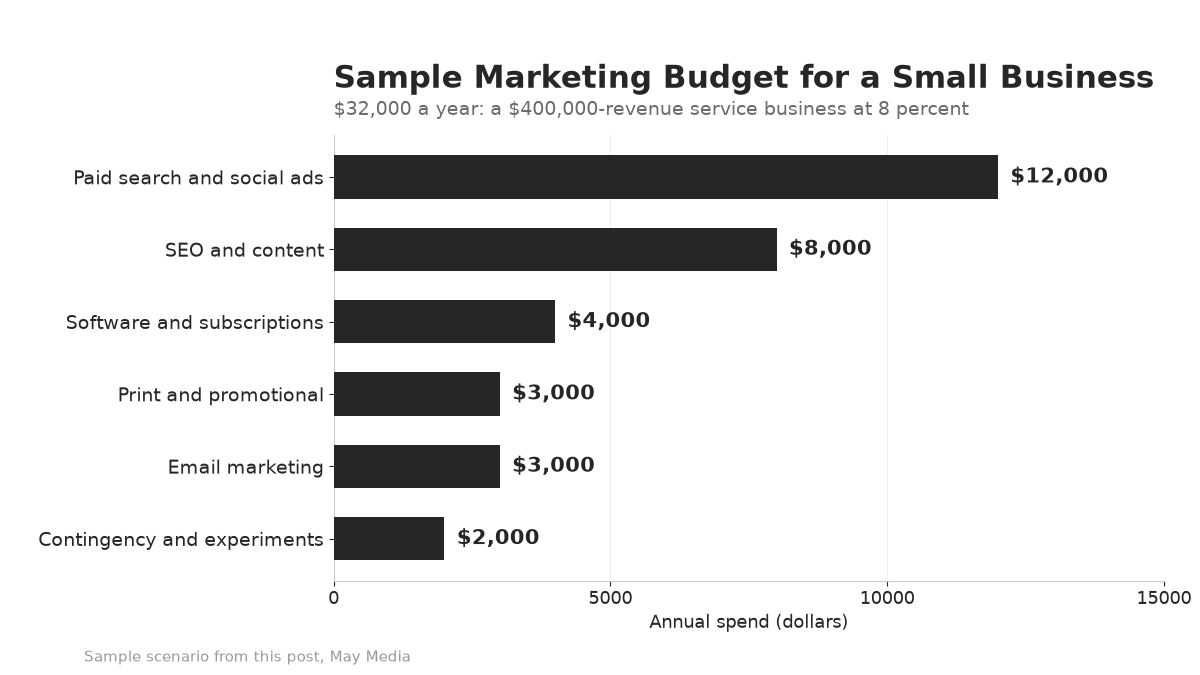
- Paid search and social ads: $12,000 (37 percent)
- SEO and content production: $8,000 (25 percent)
- Email marketing tools and campaigns: $3,000 (9 percent)
- Print and promotional materials: $3,000 (9 percent)
- Software and platform subscriptions: $4,000 (13 percent)
- Contingency and experiments: $2,000 (6 percent)
How to build a simple budget template
Open a Google Sheet with four columns: Channel, Monthly Spend, Quarterly Spend, and Goal. Set a specific measurable goal for each channel, review monthly, and update the numbers. Marketing automation tools can handle email follow-ups and lead nurturing, which lowers your cost per touchpoint as your budget scales.
What to cut first when revenue dips
Protect channels that directly generate leads or revenue. Cut brand-awareness spend first because it is the hardest to attribute and the slowest to pay back. If you must cut further, reduce the experiment budget before touching proven performers.
How Does Industry Affect Your Marketing Budget?
Why industry context changes the math
A retail brand and a B2B consultant at the same revenue level face different competitive pressures, acquisition costs, and average transaction values. A one-size-fits-all percentage ignores all of that.
High-competition industries spend at the higher end
Legal services, home services, and healthcare have high advertising costs and slow-building consumer trust. Businesses in those spaces often need to operate at the top of the 7 to 8 percent range, or above it, to stay visible.
Industry benchmarks from the CMO Survey
The annual CMO Survey published by Duke University’s Fuqua School of Business tracks marketing spend as a percentage of revenue across industries each year. Consumer product companies and B2C services consistently spend more than B2B professional services firms. Checking the most recent edition gives you a sector-specific target to compare against your own plan.
The one strategic question that sets your target
Are you trying to take market share, hold your current position, or recover ground you have lost? Taking share requires aggressive spending. Holding share requires consistent maintenance. Recovering lost ground usually requires a short-term investment spike followed by a sustainable baseline.
How Can a Fractional CMO Help You Maximize a Small Business Marketing Budget?
A fractional CMO is a part-time marketing executive who sets strategy, manages vendors, and reports on ROI without the overhead of a full-time hire. For businesses that have a budget but no senior marketing experience to oversee it, that gap can cost more than the fractional engagement itself.
Three concrete ways a fractional CMO stretches your budget:
- Auditing wasteful spend: Identifying subscriptions, ad campaigns, and contractors not contributing measurable results.
- Prioritizing by revenue impact: Ranking channels and tactics by how directly they connect to revenue, not just activity metrics.
- Building repeatable systems: Creating processes that work whether you run them yourself or hand them off.
Fractional CMO services from May Media provide the strategic layer that turns a scattered budget into a focused plan.
How Do You Know If Your Marketing Budget Is Working?
Three numbers give you enough visibility to make good decisions:
- Cost per lead (CPL): How much you spend to generate one inquiry or contact.
- Cost per acquisition (CPA): How much you spend to close one paying customer.
- Return on ad spend (ROAS): Revenue earned for every dollar spent on advertising. A ROAS of 3 means every $1 in ad spend produces $3 in revenue.
Set up Google Analytics 4 and connect your ad platform dashboards to track these numbers monthly. If a channel has not produced a single lead in 90 days, pause it and move that spend to a channel that is working. A marketing evaluation reveals exactly which parts of your current spend are producing and which are not.
Ready to Get More From Your Marketing?
Start with the 7 to 8 percent benchmark, apply a structured allocation method, and track three simple numbers each month. May Media works with small businesses across the country to build marketing plans that are specific, measurable, and built to grow. If you are ready to stop guessing and start spending smarter, reach out to the May Media team to talk through your options.