

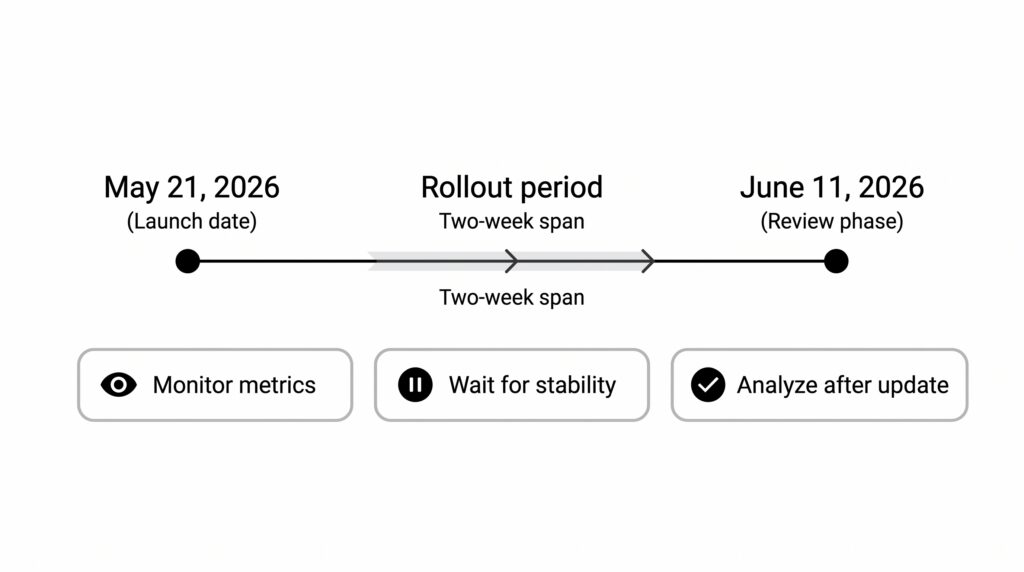
It depends: if the Google May 2026 core update has not changed your leads or traffic yet, you should watch calmly, not rush into rewrites. Google started rolling out this update on May 21, 2026, and the rollout may take up to two weeks, according to the Google core update report from Search Engine Journal.
That means you may see some movement in your search rankings, website traffic, or Google Search Console numbers before the update is finished. Some days might look great. Some might look weird. That does not automatically mean your website is “broken.”
For a small business, the smart move is simple: keep serving your customers, keep an eye on the right numbers, and wait until the dust settles before making big SEO decisions.
What Actually Happened With the Google May 2026 Core Update?
Google released a broad core update to its search systems. In plain English, Google is adjusting how it evaluates and ranks pages across the web.
This is not a manual penalty. It is not a spam action. It is not aimed at one type of business or one industry. A core update is more like Google recalibrating its recipe for what it considers useful, relevant, and satisfying for searchers.
Here is what we know so far:
- Launch date: May 21, 2026
- Expected rollout: Up to two weeks
- Type of update: Broad core update
- Scope: Global, across languages and regions
- New guidance from Google: None specific to this update
- Main goal: Better surface helpful, satisfying content
This is also the second confirmed Search core update of 2026, following the March 2026 core update.
Why Rankings Can Bounce Around During a Rollout
During a rollout, Google’s systems are still shifting. Your site might move up one day and down the next. A competitor might pop above you temporarily, then disappear again.
That is why reacting too early can make things worse. If you start changing page titles, rewriting service pages, deleting content, or overhauling your site while the update is still moving, you may be responding to noise instead of a real trend.
Think of it like checking your weight during a bumpy road trip. One strange reading does not tell the whole story. You need a stable baseline before you make decisions.
Why the Google May 2026 Core Update Matters to Small Businesses
If your website brings in calls, form fills, bookings, consultations, or store visits, then Google visibility matters. A core update can affect how often your pages show up when people search for what you offer.
For a small business, this can touch real things:
- Phone calls: Fewer or more people finding your service pages
- Contact forms: Changes in quote requests, appointments, or consultations
- Local visibility: Movement for city or “near me” searches
- Blog traffic: Informational posts gaining or losing visits
- Lead quality: More traffic does not always mean better customers
The key is not to obsess over every ranking position. The key is to watch whether the update affects the pages and searches that actually bring you business.
A Drop Does Not Always Mean You Did Something Wrong
One of the most frustrating parts of core updates is that a decline does not always mean your page is bad. Sometimes Google decides another page is a better fit for a certain search. Sometimes the intent behind a keyword shifts. Sometimes search results change because Google is testing different formats, summaries, or features.
That can feel personal when it is your business on the line, but it usually is not. Google is not saying, “This business is bad.” It is adjusting which pages it thinks best answer each search.
That difference matters because it changes your response. You do not need to panic. You need to investigate.
What You Should Do Right Now
For the next couple of weeks, your job is to monitor, not meddle. Keep your regular marketing going. Do not freeze your content calendar, but do not make dramatic changes based on one strange traffic dip either.
Here is the practical plan:
- Mark May 21, 2026 in your notes. This gives you a clear date to compare against later.
- Watch Google Search Console. Look at clicks, impressions, average position, and queries.
- Check conversions, not just traffic. Calls, forms, purchases, and bookings matter most.
- Wait until the rollout finishes. Give the data time to settle before drawing conclusions.
- Review at least one full week later. Compare performance before and after the update.
If you work with a marketing team, ask them for a simple update report after the rollout is complete. You do not need a 40-page document. You need to know what changed, which pages were affected, and whether those changes matter to revenue.
What Not to Do During the Rollout
It is tempting to “fix” everything when rankings move. Try not to.
Avoid these knee-jerk reactions:
- Do not rewrite your whole website overnight.
- Do not delete older blogs just because traffic dipped.
- Do not stuff keywords into pages.
- Do not copy what a competitor is doing without context.
- Do not judge the update from one day of data.
A core update is a good time to be alert, not frantic.
How to Review Your Site After the Update Settles
Once the rollout is complete and you have at least a week of calmer data, then it is time to review your site with a clear head.
Start with the pages that matter most to your business. For most small businesses, that means service pages, location pages, and high-performing blog posts.
Ask simple questions:
- Is this page genuinely helpful? Does it answer the questions customers ask before they call?
- Is the page specific to your business? Or could it belong to anyone in your industry?
- Is the information current? Outdated pricing, old process details, and stale examples can hurt trust.
- Is the next step clear? Visitors should know how to call, book, buy, or request help.
- Does the page match the search? A broad blog post may not rank for a buyer-ready service search.
This is where many small businesses find easy wins. You may not need a giant SEO project. You may need clearer service descriptions, stronger local details, better FAQs, updated examples, and cleaner calls to action.
What “Helpful Content” Really Means for Your Business
“Helpful content” can sound vague, so let’s make it practical.
For your website, helpful content usually means:
- It answers real customer questions.
- It explains your services in plain language.
- It shows your experience and point of view.
- It helps someone make a confident decision.
- It is written for people first, not search engines first.
If you are a plumber, your page should help someone understand when to call for a leak. If you are a med spa, your content should help someone understand treatment options, expectations, and safety. If you are a law firm, your page should explain what happens next and why timing matters.
Google updates come and go. Useful, clear, trustworthy content is still the safest long-term bet.
Where May Media Would Focus First
If we were reviewing your site after the Google May 2026 core update, we would not start by chasing every keyword. We would start by looking at the connection between visibility and business value.
That means checking:
- Top service pages: Are your money pages still getting impressions and clicks?
- Local search terms: Are city and neighborhood searches holding steady?
- Conversion paths: Can visitors easily call, book, or fill out a form?
- Content quality: Are your pages saying something useful or just repeating industry basics?
- Technical basics: Is the site fast, mobile-friendly, and easy to navigate?
If you have not reviewed your analytics setup in a while, this is also a great reminder to make sure tracking is working. You cannot make smart decisions from missing or messy data.
For ongoing support, May Media can help with search engine optimization that connects rankings to real business goals, not just vanity metrics.
Talk With May Media About Your Search Visibility
If the Google May 2026 core update has you wondering whether your website is helping or holding you back, May Media can help you sort it out calmly.
We can review what changed, explain what the numbers mean, and help you decide what is worth improving first. No panic. No jargon pileup. Just a clear plan for making your website more useful to the people you want to reach.
If you want a second set of eyes on your traffic, rankings, or content, reach out to May Media and let’s talk through your next best move.