

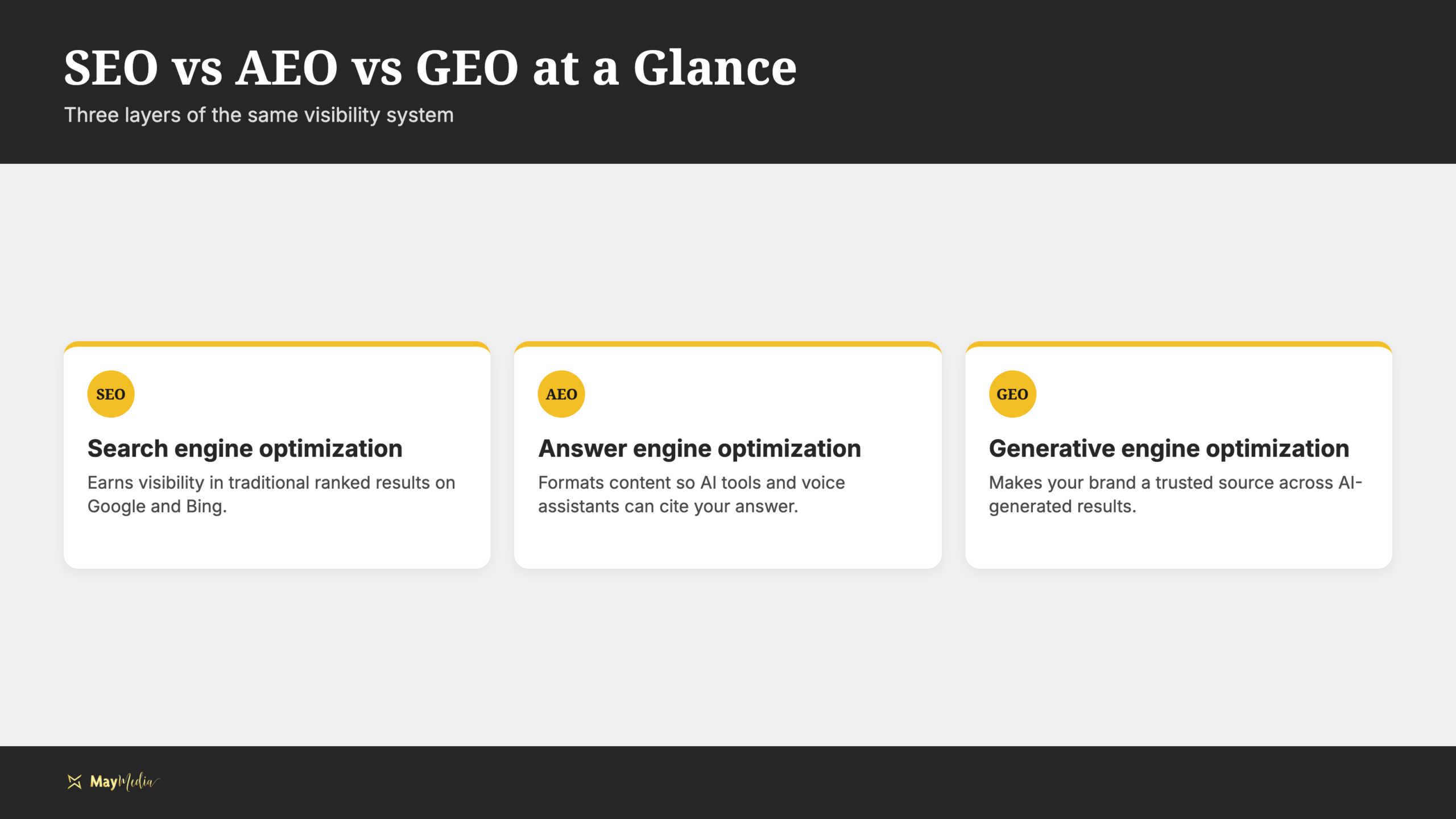
SEO, AEO, and GEO are three distinct digital marketing strategies, and understanding the difference between them is the fastest way to stop guessing where to spend your time. SEO (search engine optimization) earns you visibility in traditional ranked results on Google and Bing. AEO (answer engine optimization) formats your content so AI tools, voice assistants, and Google’s AI Overview can extract and cite your answer directly. GEO (generative engine optimization) is the broader strategy of making your brand a consistently trusted source that AI-generated results pull from across multiple platforms and query types.
What Is SEO, and Is It Still Worth Your Time?
Yes, SEO is still worth your time. Google’s own documentation on how search works confirms that traditional ranked results remain the primary way most users discover content.
How traditional ranked results still drive clicks
Organic results capture a significant share of clicks when users are comparing options, reading reviews, or finding a local service. A well-optimized page can generate consistent traffic for months or years without ongoing ad spend.
What signals Google uses: content, links, and technical health
Google evaluates three broad categories when deciding where to rank a page:
- Content relevance: Does the page directly answer what the searcher is looking for?
- Authority: Do credible sites link to this page and domain?
- Technical health: Is the site fast, mobile-friendly, and crawlable?
Why SEO is still the foundation the other two build on
AEO and GEO do not replace SEO. AI tools and voice assistants pull answers from pages that Google already indexes and trusts. Thin content or poor technical health cannot be compensated by either.
What Is AEO, or Answer Engine Optimization?
AEO is the practice of structuring content so that AI-powered tools can read, synthesize, and cite your page as the direct answer to a user’s question. The goal shifts from earning a ranked click to earning a citation inside an AI-generated response.
How AI Overviews and voice assistants decide which answer to cite
AI Overviews, voice assistants, and chat-based search tools favor pages that lead with a clear, declarative answer that is specific, structured, and easy to extract. A page that buries its answer in paragraph five is rarely cited.
The difference between ranking for a click and earning a citation
Ranking gets your link onto a results page. A citation places your answer and brand name directly inside the AI’s response, and a growing share of users read that summary without scrolling to ranked results.
Three content moves that make your page more citable
- Lead with a direct answer. The first sentence of each section should answer the heading’s question in plain declarative form.
- Use question-shaped headings. Headings framed as questions match the natural language queries that AI tools process.
- Add FAQ schema markup. Mark up your FAQ block using the Schema.org FAQPage type and verify it with the Google Rich Results Test.
How AEO connects to entity optimization and semantic search
When your content clearly defines what your business does, who it serves, and what topics it covers, search engines build a semantic map of your expertise that AEO citations draw from.
What Is GEO, or Generative Engine Optimization?
GEO is the strategy of making your brand a consistently cited source across AI-generated results on multiple platforms. AEO is about winning a single citation; GEO is about being recognized as a trusted entity over time.
What “generative engine” means in plain English
A generative engine is any AI system that composes a response from synthesized sources rather than returning a list of links. ChatGPT, Perplexity, Google’s AI Overview, and Gemini all qualify.
How GEO differs from AEO: one citation vs. consistent brand presence
AEO wins you a citation on a specific query. GEO builds the conditions that make your brand appear across many queries, on many platforms, over time.
Which platforms GEO covers
- Google AI Overview: The synthesized answer block at the top of many Google results
- ChatGPT: Used by millions for research and purchasing decisions
- Perplexity: A fast-growing AI search tool popular with professionals
- Gemini: Google’s conversational AI, integrated into search and Workspace
Why small businesses need to think about GEO now, not later
Google’s guidance on AI search features confirms that AI is reshaping how people search: users now ask nuanced questions that once took several searches. Small businesses that build authority signals now will have a head start as AI-generated results become the default.
How Do SEO, AEO, and GEO Relate to Each Other?
These three strategies are not competing options. They are layers of the same system, and strengthening one tends to lift the other two.
Semantic search: the engine underneath all three
Semantic search allows AI and search engines to understand meaning rather than matching exact keyword strings. Content that defines a concept, names related topics, and answers follow-up questions feeds the semantic understanding all three strategies depend on.
Entity optimization: how Google learns what your business is about
An entity is any named concept Google can identify and categorize: a business, a person, a product, a topic. Strong entity signals improve SEO rankings, increase AEO citation rates, and build GEO presence. May Media’s SEO services cover entity optimization alongside technical and content SEO.
A simple analogy: SEO is the road, AEO is the sign, GEO is the reputation
SEO builds the road that connects your business to searchers. AEO puts up a sign at the intersection so AI tools know to point people your direction. GEO is the reputation that makes people trust the sign is worth following.
Which One Should You Focus on First?
For most small businesses handling marketing solo, the answer comes down to where your site stands right now.
Start with SEO if your site is new or has thin content
If your site has fewer than ten pages of substantive content, or Google Search Console shows low impressions and poor click-through rates, start with SEO. Write content that answers the questions your customers are already asking.
Layer in AEO once you have pages that answer specific questions
Audit each page: does the first paragraph answer the heading’s question in plain language, and is there a FAQ block with schema markup? These changes take about an hour per page. Content management support from May Media can accelerate this.
Add GEO when you want consistent AI presence across platforms
GEO-level work, including claiming your Google Business Profile, building Wikidata entries, and earning mentions on authoritative third-party sites, makes sense once your on-site content is solid.
A quick self-assessment: three questions to find your starting point
- Does my site have at least ten pages of original, specific content? If no, start with SEO.
- Do any of those pages lead with a direct answer in the first sentence? If no, add AEO formatting next.
- Does my brand appear when I ask ChatGPT or Perplexity a question I could answer? If no, begin GEO entity work.
What Does Applying All Three Look Like in Practice?
Here is a four-step action plan you can begin this week.
Step 1: Audit your existing content for direct-answer paragraphs
Open your five most-visited pages in Google Search Console and check the first paragraph of each. If it does not answer the page’s primary question in the first two sentences, rewrite the opening. This single change improves both AEO citation eligibility and SEO engagement signals.
Step 2: Add FAQ schema markup
Add a FAQ block to any page that answers a specific question, mark it up using the Schema.org FAQPage type, and verify it with the Google Rich Results Test. Marketing automation and AI content tools can handle schema generation at scale.
Step 3: Claim and fill out your entity profiles
Claim your Google Business Profile and add a complete, consistent business description that matches your website language. If your business qualifies, create or update a Wikidata entry.
Step 4: Check your AI Overview presence monthly
Search five to ten questions your customers ask and note whether your brand appears in the AI Overview, then run spot-checks in ChatGPT and Perplexity. If you are not appearing after 60 to 90 days of consistent work, the content likely needs revision, not the strategy.
Ready to Get More From Your Marketing?
SEO, AEO, and GEO are one connected system, and every improvement to one layer strengthens the others. If you would rather hand it off to someone who does this every day, May Media works with small businesses across the country to build integrated visibility. Explore May Media’s digital marketing coaching to get a clear plan built around your business, or visit maymedia.com to see the full range of services available.