

By Jordan May, Director of SEO and AI Systems, May Media
Last updated September 15, 2026
You build an AI marketing strategy for small business by picking one repeatable marketing task, writing down how you want it done, letting the AI do the thinking and a plain script do the doing, and keeping a person on approvals. That is the whole strategy. Everything else in this post is the detail of how we run it at May Media and how a team of two or three people can copy it in 90 days.
I want to be specific here, because the guides that rank for this topic are written for a marketing department with a budget line for “AI transformation.” We are a small agency. Our AI stack is a coding agent, a written rulebook, a few data connections, an email platform, and a project board. Below is what each piece does, what we deliberately keep human, the order I’d set it up in, and what the tools cost.
What does an AI marketing strategy for small business look like in practice?
Ours runs on one idea: the AI reasons, scripts execute. We use Claude Code agents, and before any task starts, the agent reads a written rulebook. That rulebook is a folder of plain markdown files: our writing standards, our notes on every tool we use, the mistakes we’ve made and how we fixed them. The agent decides what to do; a small script does the step, whether that is pulling a report, building a document, or filing a result.
Why the rulebook matters more than the model
If you open a chat window and ask for a marketing plan, you get a generic marketing plan. The model doesn’t know your services, your voice, or the claim you got burned on last year. Write those things down once, in files the agent reads first, and the output starts from your standards instead of from zero. That is what makes AI work dependable enough to hand off, and it costs nothing but the time to write the files. Ours started as a handful of pages and grew one lesson at a time; you don’t need it finished to start using it.
Why scripts do the execution
Chained AI steps compound errors. If the model is right nine times out of ten on each step, a five-step task succeeds a little over half the time. So we keep the model on the decisions and move the mechanical steps into code that does the same thing every run. A script that pulls last month’s Search Console data pulls it the same way on the first of every month, and the AI only has to interpret it.
What do we automate, and with what?
Here is the stack, tool by tool. None of it is exotic, and every piece is something a small business can buy off the shelf.
- Reporting: Scripts pull Google Search Console and GA4 data on a schedule and feed it into reporting dashboards. The AI reads the pull, drafts the month’s observations, and flags pages that moved. We build clients’ reporting dashboards inside the retainer so they aren’t paying for a stack of separate reporting platforms.
- Email: We use Klaviyo. Claude drafts the emails from an approved brief, and Klaviyo’s visual flow builder runs the sequence. No code on the sending side; the flow builder handles entry triggers, timing, and exits.
- Content: Claude Code agents draft blogs, video scripts, and social plans against the rulebook, with keyword research from Semrush and DataForSEO and WordPress sites running Rank Math. Every blog gets an original brand-colored chart built from the post’s own content, a five-question FAQ, and BlogPosting and FAQPage schema.
- Tracking: Everything lives on monday.com boards. One of those boards is a health board that shows whether each automation ran or failed, so a broken data pull is a red item on a board instead of a quiet gap in a report.
The board that tells us when something broke
I’d put the health board near the top of your list, because the failure mode of automation is not a loud error. It’s a report that ran on stale data and looked fine. Every automation we run logs its result to that board when it finishes. If a pull fails, the item flips, a message goes to me, and nothing downstream pretends the month was checked.
What stays human?
Three things never go to the AI unsupervised, and I’d hold the same line in any business.
- Strategy: Which services to push, which audience to chase, what to spend, and what a good quarter looks like. The AI can prepare the data for those calls. It doesn’t make them.
- Approvals: Every blog, email, social post, and report gets read by a person before it moves. Our agents draft; they do not publish, so anything that lands in an inbox, on a website, or in a client’s report has a human sign-off.
- The rulebook: People write and change the standards the agents read before every task. When a draft misses, we fix the rule so the next one doesn’t.
Why the line sits there
The AI is a fast, tireless drafter with no stake in the outcome. You are the one who knows that a service was discontinued, that a client hates a certain phrase, or that this month’s dip was a tracking change and not a ranking drop. Keep the judgment calls and the customer-facing sign-off, and hand the AI everything before that point. That split is what lets a small team produce like a bigger one without the output drifting.
How does a small team set this up in 90 days?
You do not need all of it on day one. Here is the order I’d run it, one month per stage, assuming two or three people and no developer on staff.
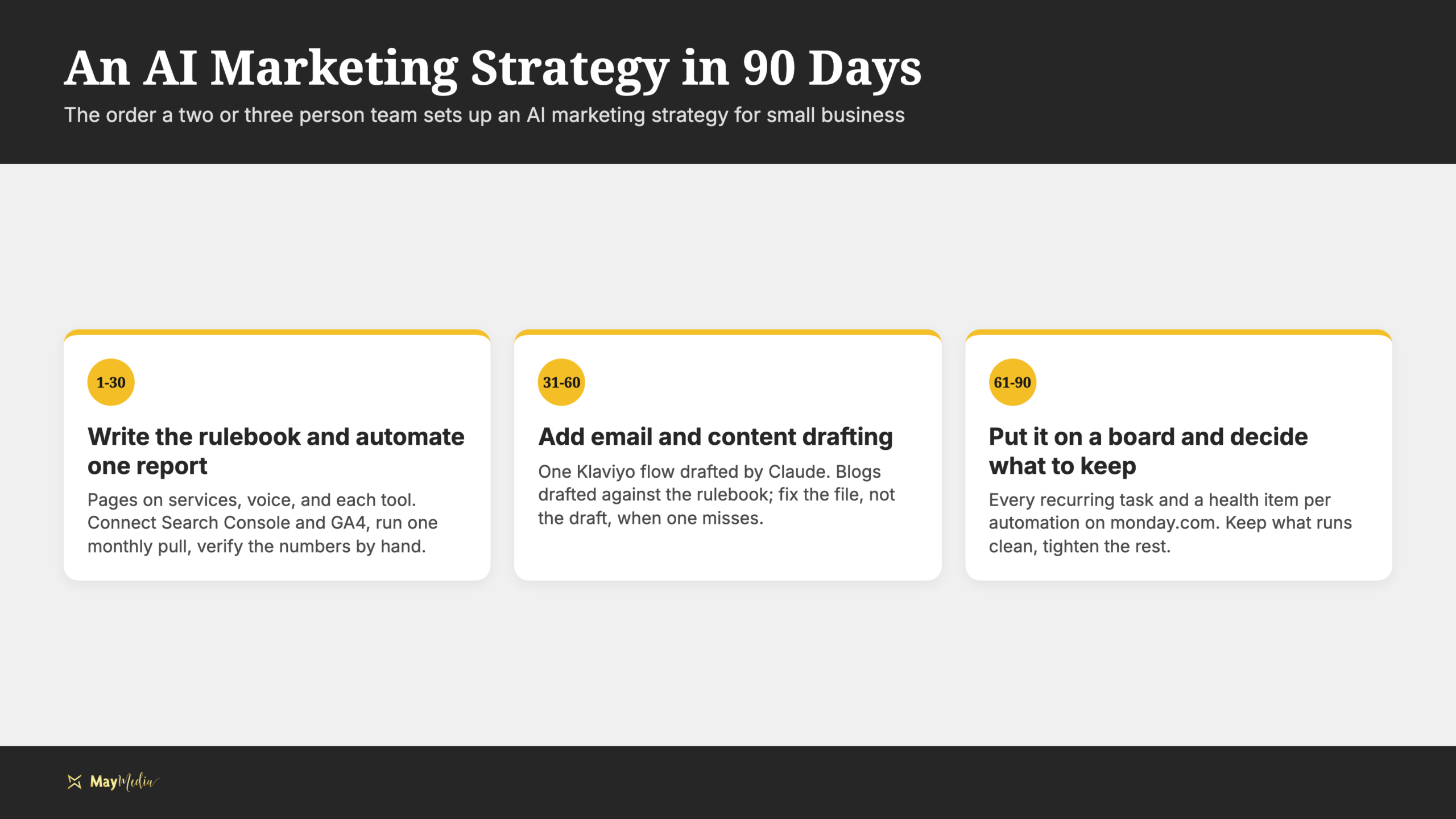
Days 1 to 30: write the rulebook and automate one report
Start with the files, not the tools. Write a page on your services and what you will and will not claim, a page on your voice with a few before-and-after examples, and a page for each tool you already use. Keep it plain text. Then pick reporting as your first automation, because the input is clean data and the output is easy to check against the source. Connect Search Console and GA4, get one monthly pull running, and have the AI draft the observations while you verify the numbers by hand.
Days 31 to 60: add email and content drafting
Now that the AI reads your rulebook, point it at email. Write one Klaviyo flow’s brief (who enters, what they get, when it stops), have Claude draft the messages, and build the flow in Klaviyo’s builder. Keep it to one flow.
In the same month, start drafting blogs against the rulebook: keyword, headline question answered in the first fifty words, five FAQs. You’ll find gaps in your rulebook every time a draft misses; fix the file, not the draft, so the next one is better. By the end of the month the drafts should need light edits instead of rewrites, and that is your signal the rulebook is working.
Days 61 to 90: put it on a board and decide what to keep
Set up a monday.com board (or whatever you already use) with every recurring task, its owner, its status, and whether the last run succeeded. Add a health item for each automation. Then look at the quarter: which automations saved time, which ones you keep overriding, and which ones you should turn off. Keep the ones that run clean, tighten the rules on the ones that don’t, and only then add the next task. Resist the urge to automate five things at once; three clean runs of one task teach you more than one messy run of five.
If you’d rather have someone map this sequence to your business, we do that on a discovery call. Talk with our team and bring one task you do every month; that is where the plan starts.
What do the tools cost?
Less than you might expect, because the expensive part is the thinking, and that is you. For the AI itself, as of September 2026, Claude’s pricing page lists Pro at $20 billed monthly with Claude Code included. That is the plan a small team starts on. The rest of the stack is tools you likely already pay for: your email platform, your analytics (Search Console and GA4 are free), your website, and a project board.
What to watch beyond the subscription
Budget for the person, not the software. Someone has to write the rulebook, read the drafts, and fix a data connection when a platform changes its API. That is hours, not dollars, but it’s the cost that decides whether the system holds up. Keyword research tools are the one line item I’d add later rather than first; a small business can go a long way on Search Console’s own query data before it needs a paid research platform.
Where an agency fits
Some businesses want to build this themselves, and the sequence above is enough to start. Others want it built and maintained. Our marketing automation services cover the second group: we set up the rulebook, the data pulls, the dashboards, and the board, and we keep the whole thing running. If you are the do-it-yourself type, this is also the kind of thing we teach inside May Media Stars, our member program.
Build Your AI Marketing Strategy With May Media
An AI marketing strategy for small business is not a software purchase. It is a written set of standards, a handful of automations that run the same way every time, and a person who approves anything a customer sees. Start with reporting, add email and content, put it all on a board, and keep what works.
We run our own agency this way, and the same setup scales down to a two-person shop. If you want help with the build, or you want to see what one of our reporting dashboards looks like against your own data, reach out and we’ll walk through it together.