

Marketing automation for small business means using software to handle repetitive marketing tasks, such as follow-up emails, lead routing, and social scheduling, so they happen consistently without manual effort. You do not need an enterprise budget or a dedicated marketing team to get started. Pick one repetitive task, automate it well, and build from there. According to the U.S. Small Business Administration’s business management guide, managing time and resources strategically is one of the most critical factors in small business growth, and automation is one of the most practical ways to do it.
What Marketing Automation Is (and What It Isn’t)
Marketing automation is software doing a marketing task for you on a schedule or in response to a trigger, without you having to manually initiate it each time. A lead fills out your contact form and gets a follow-up email within five minutes, automatically. A customer makes a purchase and receives a thank-you message and a review request two days later, automatically. That is automation doing its job.
Automation vs. doing it manually
When you do marketing manually, every action depends on you remembering to do it, having the bandwidth to do it, and doing it consistently. Automation removes all three dependencies. The task runs the same way every time, whether you are in a client meeting, on vacation, or asleep. The quality stays consistent, and the timing stays reliable.
Why it is not just for big companies
Enterprise brands spend hundreds of thousands of dollars on automation platforms, which makes the whole category feel out of reach. It is not. Small businesses often benefit more from automation than large ones do, because every manual task an owner automates is time bought back directly. Free and low-cost tools have made the barrier to entry almost zero. You do not need a marketing team or a technical background to build your first workflow.
What it cannot do for you
Automation cannot replace strategy, creativity, or genuine human judgment. It cannot write a compelling message for you, figure out what your audience actually wants, or fix a broken sales process. It multiplies whatever you feed it, which means a bad message sent automatically is still a bad message, just at scale. Use automation to execute a proven process, not to find one.
The First Workflows Worth Automating
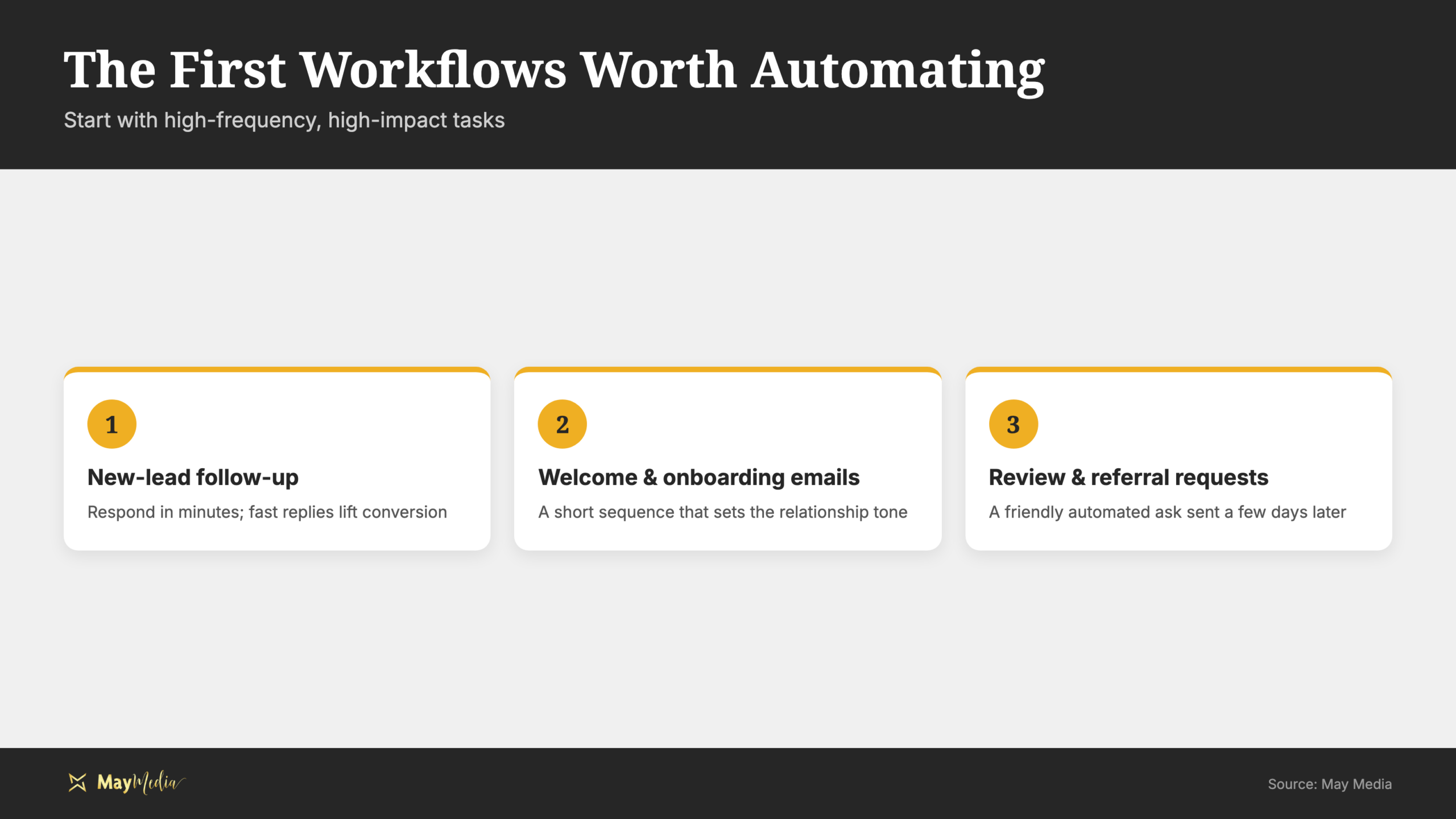
Not every marketing task deserves to be automated first. Start with the workflows that are high-frequency, time-consuming, and relatively simple in structure. These three are the right starting point for most small businesses.
New-lead follow-up
Speed matters when someone expresses interest in your business. Studies consistently show that response time in the first few minutes dramatically improves conversion rates. An automated follow-up email or text, triggered the moment a lead submits a form or contacts you, ensures no one falls through the cracks while you are busy. This is the single highest-impact automation a small business can build and the one to prioritize above everything else.
Welcome and onboarding emails
When someone joins your email list or becomes a new customer, the first few messages set the tone for the entire relationship. A short welcome sequence, two to four emails sent over one to two weeks, introduces your business, sets expectations, and moves the new contact toward their first or next purchase. Write it once, set the trigger, and it runs for every new subscriber or customer automatically. This is also a natural place to weave in your content management services if you are using content to nurture leads over time.
Review and referral requests
Asking for reviews is one of the highest-ROI activities a small business can do, and almost no one does it consistently by hand. Automate a short, friendly review request sent a few days after a purchase or completed service. You can use the same trigger to ask for referrals. The message goes out reliably, every time, without you having to remember to send it.
Choosing Tools That Fit a Small Budget
The marketing automation tool market is crowded and changes fast. Rather than recommending specific platforms, here is how to evaluate any tool for small business use.
Start with what your email or CRM already includes
Most email marketing platforms and CRM tools include basic automation features in their base plans. Before signing up for anything new, open the settings in whatever you already use and look for words like “sequences,” “workflows,” “automations,” or “drip campaigns.” You may already have the capability and just have not used it yet.
Look for free and low tiers
Many of the most capable small business automation tools offer free plans for lists under a certain size or a limited number of automations. Start there. Prove that a workflow delivers results before you spend money to scale it. Paying for a premium tier before you have a working automation is one of the most common ways small businesses waste their marketing budget.
Avoid paying for features you will not use
Platform pricing often jumps significantly between tiers because of features that large teams need, like multi-user access, advanced segmentation, or predictive lead scoring. If you are a one-person operation or a solo in-house marketer, those features are not useful to you yet. Upgrade when you have exhausted what the current tier offers, not before.
Setting Up Your First Automated Campaign
The best way to learn automation is to build one simple workflow end to end. Here is how to do it without overcomplicating it.
Map the trigger and the steps
Every automation starts with a trigger, the event that kicks the whole thing off, and a sequence of steps that follow. Before you open any software, write it out on paper or in a notes app:
- Trigger:New lead submits the contact form on your website
- Step 1:Send a confirmation email within five minutes
- Step 2:Wait 24 hours
- Step 3:Send a follow-up email with more detail about your service
- Step 4:If no reply, send a final check-in after 48 more hours
Mapping it first prevents you from getting lost inside the tool.
Write the messages once
Draft every email or message in the sequence before you build anything in the platform. Writing inside automation tools is slow and awkward. Write in a document, polish the copy until it sounds like you at your best, then paste it in. This also forces you to think through the full sequence before committing to it.
Test before you turn it on
Send every message in the sequence to yourself before activating it. Check that the timing is correct, the links work, the personalization tokens (like first name fields) pull the right data, and the message reads naturally. A broken automation that sends garbled messages to real leads is worse than no automation at all.
Common Automation Mistakes to Avoid
Small businesses that struggle with marketing automation usually run into the same few problems. Knowing them in advance saves significant time and frustration.
Automating before the process works
If your manual follow-up process is not converting leads, automating it will not fix that. It will just send a bad message to more people, faster. Test and refine your messaging manually first. Once you know the message works and the sequence makes sense, automate the proven version.
Messages that feel robotic
Automated does not have to mean impersonal. The biggest sign of a robotic automation is a message that could have been sent by anyone to anyone. Use the recipient’s name, reference the specific action they took (“Thanks for reaching out about our lawn care services”), and write in a tone that matches how you actually talk to customers. Readers can tell the difference, and personalized automated messages outperform generic ones significantly.
Never reviewing the results
Set-and-forget is the wrong mindset for automation. Once a workflow is running, check its performance every month or two. Look at open rates, click rates, and conversion outcomes. If an email in a sequence is getting low opens, the subject line needs work. If a follow-up is getting ignored, the timing or message may be off. Automation handles the execution, but you still own the strategy.
Build Your Automation Stack with May Media
Marketing automation for small business does not have to be complicated or expensive, but it does need to be set up correctly to deliver results. The businesses that benefit most are the ones that start with one well-built workflow, prove it works, and expand from there. If you would rather have a professional design and implement your automation system from the start, May Media’s digital marketing services are built for exactly that. We work with small businesses across the U.S. to build automated marketing workflows that run consistently without adding to your workload. Schedule a marketing consultation with May Media in Denton, TX, and let us show you where automation can make the biggest difference for your business.