

Yes, generative AI search is still built on the same SEO basics you already need: helpful content, a crawlable website, clear business details, and a good experience for real people. Google has now said that plainly in its new AI search optimization guide, and that is good news if you run a small business.
If you have been hearing scary phrases like “GEO,” “AEO,” “AI search hacks,” or “your SEO is dead,” take a breath. This update does not mean you need to throw out your marketing plan and start over. It means the work has shifted a little, but the foundation is familiar.
For your business, the big takeaway is simple: Google’s AI Overviews and AI Mode still pull from Google Search. So if your website is useful, easy to understand, technically sound, and built around what your customers actually need, you are already moving in the right direction.
What Google Actually Said About Generative AI Search
Google published official guidance for website owners who want to show up in AI-powered Search features, including AI Overviews and AI Mode. The important part is not that Google has a shiny new document. The important part is what the document confirms.
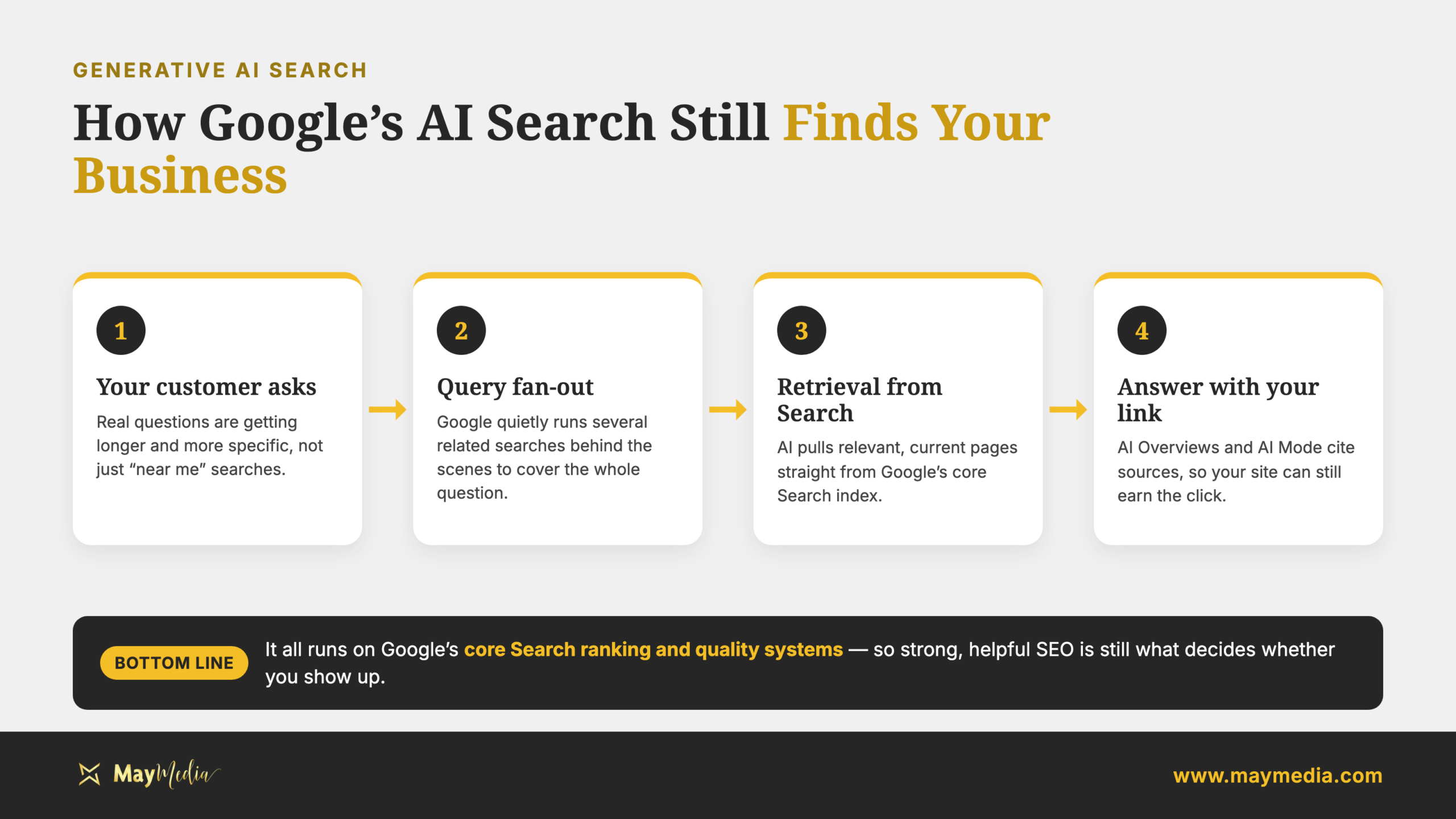
Google says generative AI features are rooted in its core Search ranking and quality systems. In plain English, that means AI answers are not living in a totally separate world. They still depend on content Google can find, understand, trust, and show to searchers.
Google also explains a few ideas that matter for visibility:
- Retrieval-augmented generation: Google’s AI looks for relevant, current pages from its search index to help build answers.
- Query fan-out: Google may run several related searches behind the scenes to answer one bigger question.
- Clickable sources: AI answers can include links to pages that support the response.
That last point matters for you. Your website can still earn visibility, even when the search result looks different than it used to.
Why Generative AI Search Still Depends on Good SEO
This is the part small-business owners should find encouraging. You do not need a separate “AI website.” You need a stronger version of the website strategy you should already have.
Generative AI search still depends on the basics:
- Google needs to crawl your site. If your pages are blocked, broken, or hidden behind technical issues, they are less likely to appear anywhere useful.
- Your content needs to answer real questions. Thin, generic posts are easier for AI to ignore because they do not add much.
- Your website needs to be organized. Clear headings, readable sections, and helpful page structure make life easier for people and search engines.
- Your business details need to be accurate. For local businesses, your Google Business Profile and website information should match.
- Your pages need to work well on phones. A slow, confusing, or cluttered site can cost you visitors after they click.
This is why steady search engine optimization support still matters. AI search is not replacing SEO. It is raising the bar for SEO that actually helps people.
The “Helpful Content” Bar Is Getting Higher
Google’s guide puts a lot of weight on unique, valuable, people-first content. That sounds simple, but it is where many small-business websites fall short.
A generic blog post like “5 Tips for Better Marketing” probably will not stand out. A more useful post might explain what you learned after running a seasonal campaign, what surprised you, what you would do differently, and what another business owner can take from it.
The difference is experience. AI can summarize common advice. It cannot replace your real stories, your customer insights, your process, or your point of view.
What This Means for Your Small-Business Website
If your website has been treated like a digital brochure, generative AI search is a good reason to make it more useful. People are asking longer, more specific questions now. Google’s AI features are built to answer those bigger questions.
For example, someone might not just search “landscaper near me.” They might ask:
- “What kind of landscaping helps a small backyard stay low maintenance?”
- “How much should I budget for a new patio and plants?”
- “What should I ask before hiring a landscaping company?”
If you are the local business answering those questions clearly, with honest detail, your website has a better shot at being part of the conversation.
Local Businesses Should Pay Close Attention
Google specifically mentions local business details and Google Business Profiles. That matters because AI search can pull together information about businesses, products, services, reviews, and locations.
For a local business, this means your basics need to be clean:
- Business name: Use the same name everywhere.
- Address and service area: Keep your location details current.
- Hours: Update holiday hours and seasonal changes.
- Services: Make sure your main services are listed clearly.
- Photos: Add real, high-quality images when possible.
- Reviews: Keep earning honest reviews from real customers.
If you serve a specific town, neighborhood, or region, your website should make that clear too. Strong local search marketing helps Google understand who you serve and when you are relevant.
What You Should Do Now
The best next step is a practical website checkup. You do not have to solve everything at once. Start with the places that matter most to your customers and to Google.
Start with these five areas:
- Review your most important pages. Do they clearly explain what you do, who you help, where you work, and why someone should trust you?
- Update thin or generic content. Add examples, process details, customer questions, photos, or firsthand insight.
- Check your technical basics. Make sure pages load quickly, work on mobile, and are not accidentally blocked from search.
- Clean up your local details. Compare your website, Google Business Profile, and major directory listings.
- Add helpful visuals. Use real photos and useful videos when they make the page better.
Think of this less like “optimizing for robots” and more like making your website easier for a busy customer to trust.
Content That Can Help You Show Up in AI Search
The best content for generative AI search usually answers a specific question with enough context to be genuinely useful. It does not need to be fancy. It does need to be clear.
Good content ideas include:
- Comparison posts: Help customers choose between two options.
- Cost guides: Explain what affects pricing without overpromising.
- Process walkthroughs: Show what happens before, during, and after a service.
- Problem-solving posts: Answer the questions people ask before they call.
- Local guides: Explain what matters in your service area.
The key is to avoid “commodity content,” which is content anyone could have written. Your goal is to publish something that sounds like it came from your business, not a generic AI prompt.
What You Can Stop Worrying About
One of the most useful parts of Google’s guide is the myth busting section. There is a lot of noise right now, and some of it is designed to sell you things you may not need.
Google says you do not need to obsess over:
- Special AI files: You do not need an llms.txt file to appear in Google’s AI search features.
- Tiny content chunks: You do not need to break every page into small pieces for AI to understand it.
- AI-only rewrites: You do not need to rewrite every sentence just to match long-tail keyword variations.
- Fake mentions: Chasing inauthentic brand mentions is not a smart long-term strategy.
This is a relief. It means you can spend your time on better work: improving your website, answering customer questions, and making sure your online presence is accurate.
Where May Media Sees This Going Next
AI search will keep changing. That part is true. But the businesses that win are probably not going to be the ones chasing every shortcut.
They will be the ones that build a website full of clear, useful information. They will keep their technical SEO healthy. They will show real proof of their work. They will make it easy for customers to understand what they offer and take the next step.
For small businesses, that is very doable.
The shift to generative AI search is not a reason to freeze. It is a reason to get more intentional. If your website has old service pages, thin blogs, missing local details, or confusing calls to action, now is a great time to fix them.
Talk With May Media About AI Search and SEO
If Google’s new guide has you wondering whether your website is ready for generative AI search, May Media can help you sort through what matters and what does not.
We help small businesses turn confusing digital-marketing changes into practical next steps. If you want a clearer website, stronger SEO, better local visibility, or a content plan that actually supports your goals, reach out to May Media and let’s make your next move a smart one.